Tourism grants go to familiar faces as city seeks ways to get ‘heads in beds.’
Published 10:15 am Tuesday, November 3, 2009
The City of Issaquah’s Lodging Tax Advisory Grant Committee (LTAC) doled out more than $100,000 to local tourism and promotion groups last Friday, money raised by a 1 percent tax on hotels and motels in the city.
The purpose of the grants center around the idea of getting “heads in beds,” bringing people to Issaquah to visit built and natural attractions, and hopefully getting them to stay and spend tourist dollars in restaurants, shops and hotels.
Of the $110,750 handed out, the lion’s share went to the Issaquah Chamber of Commerce.
It received $70,750 to continue the operation of the Issaquah Visitors Center, print tourism brochures to be displayed in cities around Washington, and to put the finishing touches on a web site, discoverissaquah.com, which is about 90 percent ready and should be fully operational by January of next year.
The Issaquah Salmon Days Festival received $19,000, to continue promotion of the event around the state.
Those hoping that the LTAC committee might have been able to use the funds to inspire new and innovative promotions for the city will have been disappointed.
Without exception, the money went to continue existing programs, or to support the ongoing work of groups which have been a part of the Issaquah tourism scene for many years.
The Issaquah Historical Society received $16,000, to continue its trolley restoration project, which it is hoped will one day run between Gilman Village and downtown Issaquah.
But the historical society’s request for $8,000 to print and distribute rack cards and pay for the design and set-up of a more developed web site was turned down.
The smallest of the grants was the $5,000 given to Friends of the Issaquah Salmon Hatchery (F.I.S.H) to expand their very popular docent program.
The money will be used to provide more educational materials to visitors, and train more volunteers in the hope that the docent program may one day include regularly scheduled tours on the weekend.
“I personally think the Fish Hatchery is one of the most important things we do,” said committee member Ken Stockdale, of the Holiday Inn, before the committee unanimously agreed to the application.
An application from the City of Issaquah’s Parks Department for $20,000 to print maps and brochures was denied, with LTAC members Stockdale, Councilmember Eileen Barber, Will Parkinson from the Hilton Garden Inn, Barb Justice from the Issaquah Historical Society and Skip Rowley representing tourist promotion group Outside Seattle, feeling that this should be paid for out of the city’s general fund.
PR firm LaBrue Communications, whose principal Terry LaBrue was not on hand to present his case, was denied an application for $16,950 to provide public relations services promoting the city in newspapers, travel magazines and web sites.
There was interest in his proposal, however, with Parkinson saying “I wouldn’t fund it today, but I’d like to know more.”
Rowley said it was “premature,” but agreed that “lure” pieces, which PR firms specialize in, are an important part of attracted tourist activity.
“Leavenworth has their picture, and the wine country has theirs, but we haven’t really developed ours yet,” Justice added.
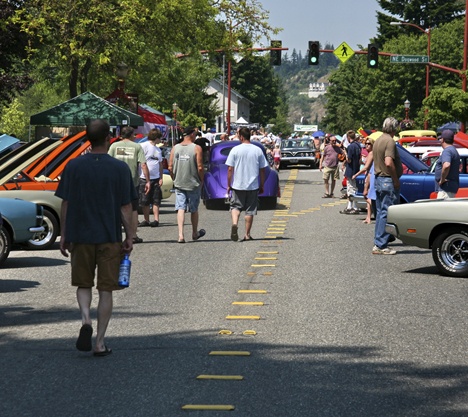
Perhaps the hardest done by were the promoters of the Fenders on Front Street event, which has proved itself to be a valuable attraction, bringing car enthusiasts to Issaquah from all over the state.
“A heck of a lot of people come to this thing,” Rowley said of the Summer event which is held in conjunction with Mountains to Sound Greenway Days. Stockdale said that his hotel received a lot of business from the event.
The Downtown Issaquah Association was requesting $2,500 to market the event in Eastern Washington.
Despite an agreement that the event was well-attended, the committee turned down the application, without a coherent explanation.
Rowley suggested the group look for sponsorships.
ArtEAST was denied an application for $18,120 for a part-time PR and marketing assistant, and a year’s listing in regional arts guides.
“They are a great asset to our community, the interest they generate with the art walk, for example,” said Rowley. “But I feel this is the wrong venue (for funding).”
The Village Theatre, one of the city’s most successful drawcards, was turned down in their application for $20,000 “to advertise and promote Village Theatre’s program outside of Issaquah; to provide information about overnight accommodations; and to increase the awareness of arts
programming, specifically family theatre, and other attractions in Issaquah.”
Despite a thorough and informative presentation from Village’s Director of Development Louise Kincaid, which included facts such as of the 175,000 patrons of Village Theatre productions each year, 84 percent of them come from outside Issaquah, the LTAC felt that the city already provided a good deal of financial support for the theater.
This support amounted to $65,000 in 2009, $45,000 of which came from the Arts Commission fund which is raised from a small percentage of ticket sales at the Regal Cinema in Issaquah.
“The Village Theatre is fabulous. I ushered there for many years,” Justice said. “They are definitely a star attraction. But in these lean times, I feel we should wait.”
The $110,750 in grants consumed most, but not all, of the estimated $125,084 in Lodging Tax funds the LTAC has at their disposal. Though this figure is just an estimate, and the actual value of the Lodging Tax fund will not be known until the middle of next year, hence the need for some buffer.
The LTAC recommendations will go before the city council, probably in December, to be approved as part of the city budget.
“We will push this out as quickly as we can,” Barber said.