Art from nature | Issaquah artist finds inspiration in fossil-like rocks
Published 4:10 pm Wednesday, December 4, 2013
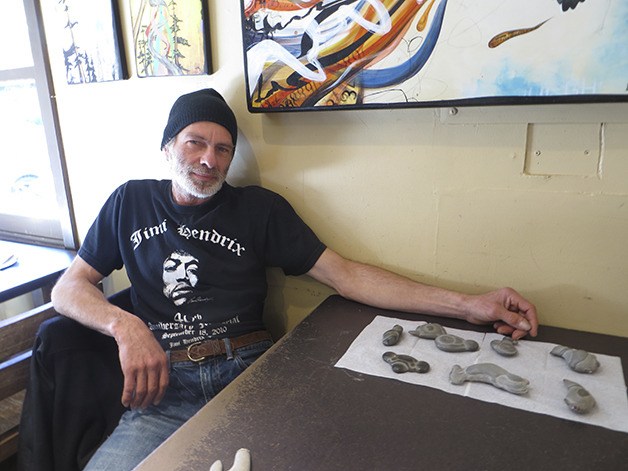
Bill Sullivan hasn’t exactly had an easy life. While he is positive and seems to be happy, he’d prefer not to be homeless.
A series of unfortunate events led him to homelessness. In 2010, while bicycling in Issaquah, he was hit by a 17-year-old girl who was texting while driving. A serious shoulder injury sidelined him, so he lived in a Chevy Van until he received a $16,000 settlement. He then bought a 30-foot motor home to live in. The motor home was stripped and left at the side of a road, leaving him with a car that runs sometimes and a tent.
Growing up in the area he collected rocks since he was a little kid, but he’d never seen anything like rocks called “concretions” which he discovered about 20 years ago.
“I was fascinated by them; I collected as many as I could,” Sullivan said.
According to the Royal Museum in British Columbia, concretions look like a fossil, or an animal carving by some ancient culture. To the untrained eye they look as though they may have been made by humans. Concretions originate in soft sediment such as sands, soft sandstone, clays and shales. They are hardened areas, usually of a different color inside another rock.
The size of concretions appear to be determined by the permeability of the host rock.
Sullivan came across them when he was first homeless and camping in the woods near the Snoqualmie River.
“Things were a lot more unpopulated,” he said. “Branching off there, I’d find them in the rivers.”
At a job working for a kitchen and bath design company he learned how to polish marble, a skill he put to use after unsuccessfully trying to paint some of the concretions he found. Using different grits of sandpaper and hours of devotion, he found he could create a work of art in unison with Mother Nature. He has trained his eye to see the shapes, and then polish and refine them.
“They kind of bring out themselves,” he said.
For the most part, they look like animals, although one he found and polished, brought out a remarkably accurate image of the Seahawks logo. He took it to the Seattle Seahawks training facility in Renton with a letter for coach Pete Carroll and the team, suggesting they auction it off for charity.
“I haven’t heard anything from them, but they haven’t lost since I took it to them,” he said.
Sullivan said one of his inspirations is the artist Peter Max, best known for his ‘60s and ‘70s pop art. He recently heard Max speaking about his art on a radio show.
“He was talking about how he was influenced by monks in the beginning,” Sullivan said. “When he was first discovered, he got all these awards for creativity. He thinks the next phenomenon will combine science and art, which is what concretions are.”
Sullivan also plays guitar and believes Jimi Hendrix is his guardian angel.
Once, when he was out of work, he went to visit Hendrix’s grave in Renton.
“As soon as I touched the grave, my phone rang and it was work!” he said.
His artistic and musical talent may be hereditary. His father, Bill Sullivan Sr., was a professional musician who played the clarinet in the 1962 World’s Fair Band. He died of cancer in 1968 when young Bill was only 13. Sullivan’s mother, Mildred, was a paste-up artist for the Seattle Times and the Seattle PI back when “they really used paste,” he said. She succumbed to cancer in 1985. With no siblings, Sullivan has been on his own since then.
Sullivan said he has never given up on his goals and dreams and feels he has guardian angels all around him. On the evening of Nov. 29, as he was sleeping in his tent in the pitch black, he heard two snaps, a crack and a thud which shook the ground.
The next morning he saw that an 80-foot tree had crashed to the ground no more than 15-feet from his tent.
“There was no wind; it fell to the east – I was directly west of it,” he said.
Sullivan volunteers at the Issaquah Food and Clothing Bank once a week. His concretions are for sale for as low as $20 for a single polished stone, up to $500 for more elaborate figurines.
Contact Sullivan at concretionartwork@yahoo.com to see his work up close.

A close-up of the duck concretion by Bill Sullivan.

A close-up of the whale concretion by Bill Sullivan.