
Ater zHome, ‘green’ home development continues in Issaquah Highlands
Published 3:01 pm Thursday, March 10, 2016
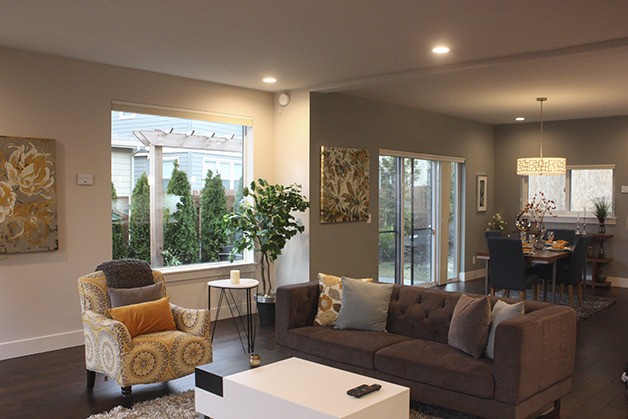
Last December, a “net zero energy” town house development in the Issaquah Highlands made headlines after residents reported receiving checks for the electricity they were selling back into the power grid.
Now, the Japanese-American company responsible for zHome is selling out its latest development.
Located less than a mile from zHome in the Highlands, Sun Ridge is not a condominium complex — it consists entirely of two-story standalone homes. Nor does it claim to be “net zero energy.”
But Ichijo USA has incorporated zHome’s concept of extensive 3.42 kilowatt solar paneling to supplement the power homeowners buy from the grid.
“It’s possible to have half of your energy covered by solar power,” Amy Tovel, marketing director, said.
In Japan, Ichijo Koumuten has built custom houses since 1978. The company became known for its development of “i-cube” panels in 2008, which allowed houses to be built modularly on-site after the individual parts were constructed indoors.
Subsidiary Ichijo USA was founded in 2009 under the same custom-built business model. But the company has since expanded into speculative development, beginning with zHome in 2011. The company has additional developments in Kent and executives plan to open another town house complex in Redmond this summer.
 Amy Tovel, the marketing director for Ichijo USA, stands outside a row of homes in the company’s Sun Ridge development. Carrie Rodriguez/staff photo
Panels and energy-efficient fixtures for the homes are manufactured by Ichijo Koumuten in the Phillipines and shipped over.
“Cabinetry, doors, windows, panels — they all come from the same facility,” Tovel said.
The cost of a home in Sun Ridge runs between $700,000 and just north of $1 million. The steepness of the price mostly reflects the cost of living in Issaquah — in Ichijo’s Kent developments, the same homes sell for about $300,000 less.
Nevertheless, Sun Ridge has proven popular. Since beginning construction a year ago, Ichijo USA has sold 30 of its 35 available homes.
Energy-efficient building has become increasingly popular among both developers and homebuyers, Leah Missik said. Missik is the program manager for Built Green, a nonprofit program of the Master Builders Association that sets and evaluates environmentally friendly standards for residential construction in King and Snohomish counties.
“You can’t really parse out who came first — green developers or buyers who want green homes,” Missik said. “It’s the chicken and the egg.”
But Missik said the past three to four years saw an explosion in membership in the Built Green program.
In 2015, more than 900 projects applied for a Built Green score. The score summarizes a home’s energy efficiency and sustainable material use using a system that runs from three stars to five stars, with a recently introduced “Emerald Star” certification for extremely sustainable projects, like zHome.
“In the beginning, there was a perception that building green is more expensive,” Missik said. “And that’s not necessarily true. But builders who are new or unfamiliar with sustainable construction methods could run into situations where it’s expensive early on.”
Market popularity may have encouraged more builders to hop onto the sustainability bandwagon. Missik said a realtor who works with the Built Green program analyzed data in the Multiple Listing Service in 2014 and found that Built Green homes spent less time on the market and sold at a higher price per square foot.
In 2015, 47 percent of new single-family residential construction in the Seattle was done under the Built Green program, Missik said.
“We’ve hit a market penetration point where it doesn’t seem really out there,” she said. “Just different.”