Confirmed death toll rises to 2 from chemical tank blast in Longview
Published 4:09 pm Wednesday, May 27, 2026
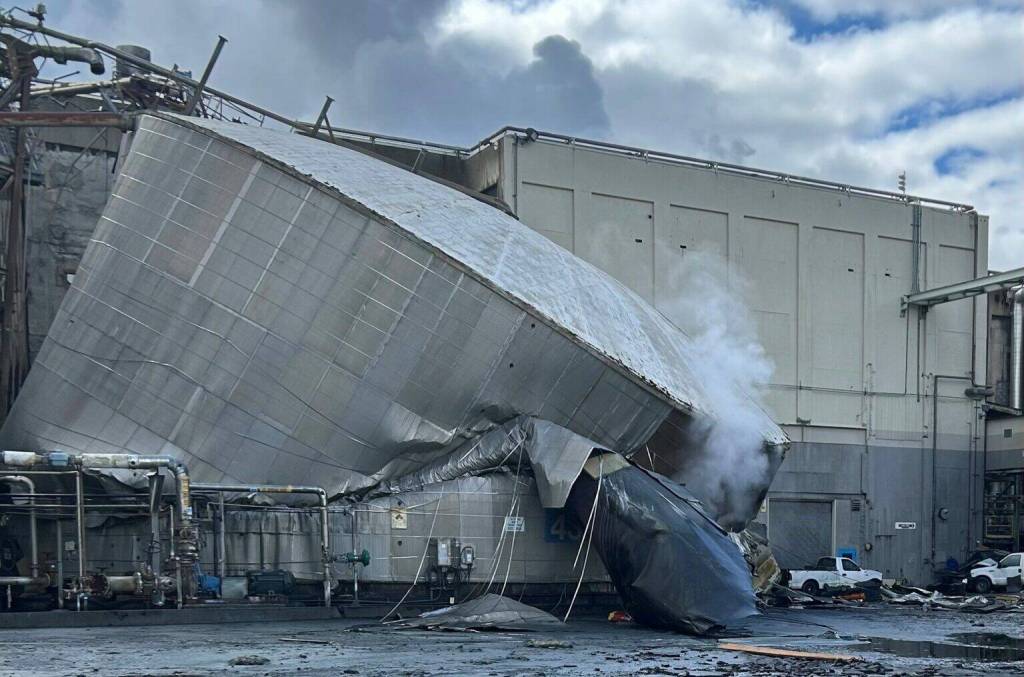
The death toll from the May 26 chemical tank rupture at a mill in southwest Washington has climbed to at least two people, while nine others remain “unrecovered,” according to authorities.
Longview’s Fire Department said late Wednesday morning that a person transported from the scene for medical care after the tank burst had died from their injuries. Authorities confirmed the first fatality on May 26.
“We’re bracing ourselves for this being the deadliest industrial tragedy in modern Washington state history,” said Gov. Bob Ferguson.
Seven other employees remain hospitalized with injuries. An injured firefighter has been released from the hospital, said Matt Amos, Longview Fire Department battalion chief.
A tank holding more than half a million gallons of a corrosive substance known as white liquor erupted the morning of May 26 at the Nippon Dynawave Packaging plant. White liquor is used in paper manufacturing. It can cause severe burns upon contact with skin.
First responders indicated that they did not expect to rescue additional survivors from the site.
“We declared this incident a transition from rescue to recovery as of this morning,” Cowlitz 2 Fire and Rescue Chief Scott Goldstein said May 27 at a noontime press conference.
He said that responders did not know the locations of all nine missing individuals within the mill.
Family members identified one of the deceased as Gilbert Bernal, who was described as a beloved father, grandfather and member of his local church.
Chemical spilled into river and ditches
Some of the chemical flowed into the nearby Columbia River and into a local diking system, state and local officials said Wednesday.
Nippon Dynawave found “spikes of high pH material” from the plant into the river in the aftermath of the rupture, said Brian Wood, the company’s director of support services.
This issue was reported to the state Department of Ecology. Prolonged exposure to high pH water can have harmful effects on wildlife, including decreased reproduction and growth as well as damage to skin, gills and eyes, according to the U.S. Environmental Protection Agency.
White liquor went from the company’s storm drains into the diking system, which turned off its pumps Tuesday morning. About a dozen dead carp have been recovered from the dikes, Ferguson said.
State and local officials have said there are no threats to air quality around the site or to the local drinking water system. They are asking people to stay away from ditches and dikes around Longview until water testing is completed.
The company will be cooperating with investigators and looks forward to “a full and complete investigation,” Wood said.
“These are our people,” he said. “We are focused on our people. We are focused on helping our responders find and recover those people.”
As individuals are recovered, they will have to undergo decontamination before being transported to the Cowlitz County Coroner’s Office for identification and family notification.
“The priority is ensuring responder safety while treating every victim with the greatest dignity, care and respect as possible,” said Amos.
Tank less unstable than initially thought
The response effort paused Tuesday due to concerns that the tank remained unstable and still contained thousands of gallons of the dangerous chemical.
Further assessments showed the tank was less risky than initially thought. Goldstein clarified Wednesday that an earlier estimate that the tank still held around 90,000 gallons of white liquor was high, and the amount was likely closer to 25,000 gallons. It is leaking slowly out of the tank.
Previously, officials indicated the tank contained 900,000 gallons of white liquor. Goldstein revised that figure as well, saying the tank’s capacity was 900,000 gallons and that it was filled with roughly 600,000 gallons at the time of the blast.
It wasn’t clear based on the information officials shared on Wednesday where the chemical that spilled out of the tank ended up, or how much spilled into the river.
To help at the scene were 46 members of the National Guard, including 10 Civil Support Team members supporting the Department of Ecology on air quality monitoring. The National Guard team specializes in responding to chemical incidents.
The Homeland Response Force had 20 members there to help with decontamination and another eight from Fatality Search and Rescue to assist with recovering bodies.
Also on Wednesday, the U.S. Chemical Safety and Hazard Investigation Board announced it would open an investigation into the tank failure. The federal agency said a team of its investigators would arrive in Longview on Wednesday.
“The CSB is opening an investigation into this tragic incident to determine how it happened and what can be done to prevent something like this from happening again,” said Steve Owens, chair of the board.
The board is responsible for investigating incidents involving the catastrophic release of extremely hazardous substances. It works to identify root causes and issue recommendations, but does not issue citations or fines.
Washington State Standard is part of States Newsroom, a nonprofit news network supported by grants and a coalition of donors as a 501c(3) public charity. Washington State Standard maintains editorial independence. Contact Editor Bill Lucia for questions: info@washingtonstatestandard.com. Follow Washington State Standard on Facebook and Twitter.