Green-tech interest grows in Issaquah
Published 10:03 am Thursday, July 16, 2009
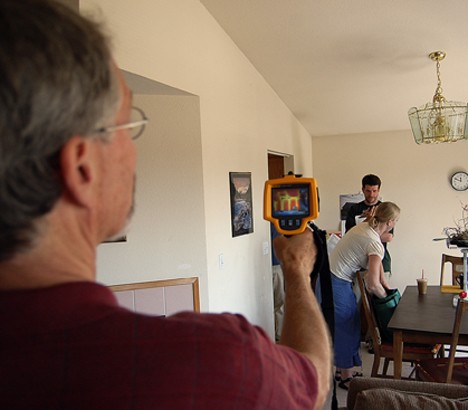
Issaquah’s Gary Wood points what looks like a radar gun at a seemingly innocuous corner of the room. We are standing in a home in the Seattle neighborhood of Maple Leaf. It looks no different to most of those around it – spacious, homely, the sort of house in which homeowners all over Washington have been raising families for years.
But in many ways this particular house represents a more remarkable future, as a training home for the growing science of energy auditing.
That gun in Wood’s hand captures thermal imaging – in a viewfinder in the back of the device the user can see very precise temperature variations in the walls and doors and windows it surveys.
Although we can understand how cracked windows and open fireplace flues leak heated air and drive up our energy bills, the picture that the thermal camera reveals is altogether more surprising. Cool air seeps in through the wall at the beams and joists, and gathers along the seam with the ceiling, all clearly illustrated by the camera which recognizes variances of a fraction of a degree.
Earlier in the day Wood had observed how energy inefficient leaks could be pinpointed by sealing the doors of a room and running a large, industrial strength fan through the enclosed space, then measuring the pressure difference between the test room and those adjacent.
They studied low-tech methods too, such as burning an incense-like stick and seeing how the smoke would escape through power outlets.
For Wood the concept of making homes more energy efficient is one that has interested him since the 1970s, when the oil and energy crisis of that era brought the idea of “zero energy,” and “passive” homes from countries like Germany, to America.
Back then, however, once the oil crisis passed, the nation’s interest in energy efficiency largely waned, Wood said.
This time around, he believes that the convergence of environmental interests with government and commerce will help propel energy efficiency into the everyday lexicon.
Wood runs his own residential remodeling business in Issaquah, and is one of the founding members of Home Performance Washington (HPW), a non-profit association formed this year to promote the benefits of energy audits and retro-fitting homes to make them more energy efficient.
He was also one of several area building industry professionals to attend the first meeting of the Green Energy Club late last month, a group started by local Matt Tighe to discuss developments in alternative energy and what it might offer to cities on the Eastside.
HPW is one of several groups that have sprung up in recent years to accommodate a growing interest in reducing energy consumption in housing.
The Building Performance Institute, and the Residential Energy Network, are two others, and it is through them that energy auditing classes, like this one in Maple Leaf, are being held to teach and accredit people like Wood.
“It’s the hot issue in the building and renovation industry,” he said. “But there is not a lot of structure around it yet. So you get operators claiming to be energy auditors or efficiency experts, when there is still not a clear understanding among homeowners of what that means.”
He said that what was exciting about energy efficiency was that it didn’t rely upon appealing to people’s environmental or political senses.
“This is about money for a lot of people,” he said. “Everyone’s thinking, ‘what can I do? Should I get new windows?’ Well, windows may be a solution, but is that the best solution? What energy auditing like this does is to help homeowners figure out what they can do to get the best return. A big part of auditing is about advising, rather than selling.”
Wood said that groups like HPW also focused on the socioeconomic benefits of better functioning houses. For example, there are discussions between government agencies about funding energy efficiency improvements for low-income housing.
“The idea is that rather than paying people to pay their bills, you pay to fix the homes so the bills are far less,” Wood said. “It’s a fix rather than a leak. In less than a few years the improvements have paid for themselves.”
While efficiency requirements are now a bigger part of new house construction, that is only a small part of the housing market.
“Homes built before 1970 use nine percent of the nation’s total energy consumption,” Wood said. This is more than all the houses built since 1970 combined. “And looking ahead to the year 2050, 75 percent of all houses then have already been built by now. So the retro-fitting business is where the big savings will be.”
For those interested in real estate markets too, how energy efficient a house is now has a bigger impact on its resale value. That trend will only continue, Wood said, citing the market in the UK where in some cities an energy audit is a requirement of any home sale transaction. Elsewhere, people who chose to buy an energy efficient home qualify for a low energy loan, with better rates.
“So this is something that the mortgage industry is getting into as well,” Wood said.
In many ways the City of Issaquah is already ahead of the curve when it comes to energy efficiency concepts like these.
We have all heard about the heralded zHomes project in the Highlands, a the nation’s first LEED certified fire station. Less known are companies like Terry Phelan’s Living Shelter Design, which promotes the use of environmentally sound building practices.
It is the forging of pathways like these, intersecting the worlds of environmental activism, technology, building and finance markets, and sustainable living, that locals like Wood and the Issaquah Green Energy Club will continue to explore in future meetings.
For more information on the Green Energy Club, e-mail matttighe@gmail.com
For more information on Home Performance Washington, go to www.homeperformancewashington.org.
To contact Gary Wood, e-mail gary@homenrgperformance.com.