
Hiking the High Point Trail – A walk through history
Published 8:00 pm Thursday, October 11, 2012
By Thomas Anderson
The “High Point Trail” remains a popular hiking destination today, but few know that the path is also steeped in history.
Along the trail that is today used as a favorite recreation spot, there was once the old “Wooden Pacific” logging tram, which was used to bring logs down the steep north slope of Tiger Mountain to the High Point Mill until the 1920s. Walking the trail at present is a lesson in the rich logging history of the area.
The most immediate observation is how the old road is crumbling and being consumed by nature after decades without repair. Compare it to the engineering marvel we call I-90 — a testament to progress in our transportation infrastructure as well as a reminder of how quickly the works of man crumble into dust.
Past the second gate and over a small bridge crossing the High Point Creek is a chance at a first-hand glance at engineering marvels of the past. Deep grooves worn into the ceiling near the creek remain from the steel cables that lowered the tram cars down the slope. The cables were attached on the uphill end to a steam donkey engine, as much as 5,000 feet away. The small pond nearby is known as “High Point Lake,” somewhat of a misnomer given its size.
Sometime after the tramway ceased to be used, the route was bulldozed for the installation of an electrical power line to the summit of West Tiger Mountain. Thus, the log rails are gone, but there are electrical junction boxes along the lower part of route, which remain as visible remnants of the route. Other signs of the former logging operations remain, such as steel cables and stumps girdled for use as anchors for the logging operations.
About one mile farther is the intersection with the Tiger Mountain Trail, where a large stump on the that was once girdled for logging operations still sits.
Continue on the trail upward for another quarter of a mile and watch for the TMT “12” mile marker sign on a tree (elevation 1,720 feet). Looking downhill from there is the old Wooden Pacific route, now engulfed in trees and underbrush. Power poles are still standing, the remnants of the power line to the summit of West Tiger. Upward on the TMT is the intersection with the West Tiger Rail Road Grade, which was also the upper end of the middle segment of the Wooden Pacific tram.
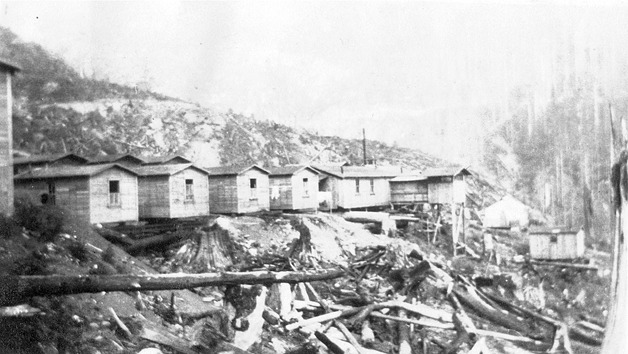
This stretch of the trail passes through a former logging camp operated by the High Point Mill, where logging relics stand along the route.
The West Tiger Railroad grade trail is another point to continue along, while a turn in the opposite direction leads down the mountain to the parking lot.
Throughout the miles of trail and thousands of feet in elevation are serenity and an opportunity to connect with the nature and history that defines the Issaquah-Sammamish area.
Thomas Anderson is a docent for the Issaquah History Museums.

An excellent example of a tree “girdled” for logging operations along the route of the old Wooden Pacific. This probably served as an anchor for a spar pole.

Watch for logging artifacts along the trail — like this old cable.
Thomas Anderson photo