Eastlake juniors named finalists in national ‘Genes in Space’ contest
Published 5:06 pm Wednesday, July 15, 2015
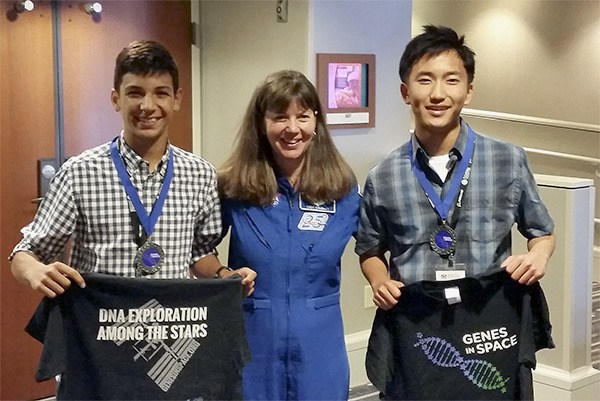
Two Eastlake High School juniors were in Boston last week presenting their proposal to test a particular bacteria’s DNA about 220 miles above Earth’s surface.
If they could figure out what makes the OU-20 bacteria special — to identify how it survived for more than a year and a half on the outside of the International Space Station from 2008 to 2010 — Thiago Bandeira, 16, and Jonathan Chang, 17, could influence the future of agriculture.
But before they could jump to farming on Mars, they had to contend with many variables, including winning the contest that would make their proposal a reality.
“The project was really, really hypothetical,” Bandeira said. “It’s pretty cool because you get to wonder.”
They were named finalists in the national “Genes in Space” contest; the winning experiment will be conducted on the space station.
Students, grades 7-12, were tasked with designing an experiment that, through DNA analysis, would solve a real-life space exploration problem. The five final teams gave presentations at the three-day ISS Research & Development Conference in Boston July 7.
Every contestant’s experiment involved the use of PCR (polymerase chain reaction) technology. This technology is widely used on Earth, but has never been tested in space before, Harvard Assistant Director of Undergraduate Studies Martin Samuels said.
Every finalist was matched, for coaching purposes, to a scientist with a Ph.D. Leading up to the conference, Samuels mentored Bandeira and Chang, talking through the specifics of their proposal, examining the realities and unknowns.
“They are both very motivated, bright, and they’re really creative,” Samuels said.
The miniPCR machine, the specific brand and type to be used in the space experiment, essentially copies small segments of DNA for close analysis.
Bandeira and Chang had hoped to use the technology to find and examine the bit of DNA that gives the OU-20 bacteria its ability to survive extreme temperature shifts, ultraviolet light and cosmic rays.
“Genes in Space allows students to explore a tremendous amount of potential questions while focusing around one particular type of experiment (PCR) in one particular context (aboard the ISS), … while emphasizing the rigor in experimental design required to ask a particular question,” Samuels wrote in his “Meet the Mentors” post on the Genes in Space website.
As a reward, the finalists’ school will receive a new miniPCR machine.
 Bandeira said this “fancy” machine — as compared to the older one they currently use — will be a good edition in the classroom for their bio-tech teacher, Lara Hollingworth, who has been teaching for seven or eight years at Eastlake.
Hollingworth had initially assigned the Genes in Space contest as homework, building off the course material that had been using the PCR machine to examine DNA sequences, but Bandeira and Chang were the only ones to submit it to the contest.
“I gave them all the skills to really understand DNA and they took it to another level,” Hollingworth said.
The partnership of Boeing, the Center for Advancement of Science in Space, Math for America and miniPCR launched the contest for foster creativity, collaboration and critical thinking in young minds. Bandeira and Chang were chosen from a group of 330 applicants from across the country.