Let’s get moving | BoostRide could change the way we commute
Published 5:35 pm Wednesday, February 19, 2014
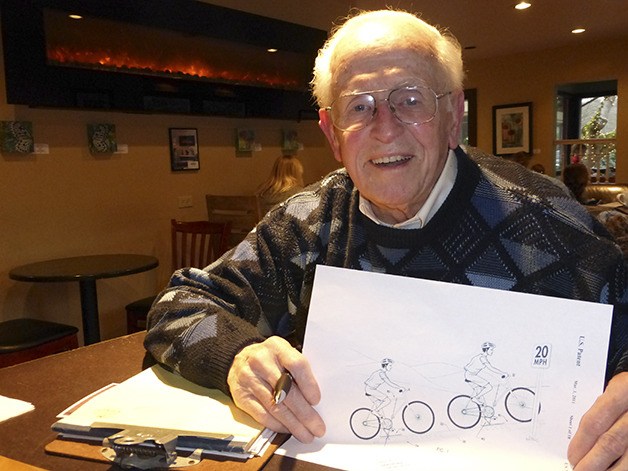
Talking with Issaquah resident Pat McGrath, a retired aerospace engineer, you can see in his eyes the spark and enthusiasm for ideas. McGrath is an inventor, who holds five U.S. patents.
His most recent patent/invention, called BoostRide, could change the way people commute, moving 3,300 commuters per hour at a speed of 20 mph, instead of 2,100 vehicles per hour, per freeway lane, belching out pollution.
BoostRide uses a Linear Induction Motor (LIM), which he said is the same technology used for launching a modern catapult off of an aircraft carrier.
Any bicycle with a 26-inch wheel will work.
The bicyclist attaches a six-pound secondary LIM, which is made out of aluminum and steel, to the bike. It’s easily removable for the biker to leave behind if they’re not using the primary LIM.
The primary LIM is a system of coil assemblies – made of iron, wrapped with copper, and encased in epoxy so thieves can’t steal the copper – flush with the surface of the roadway, powered by 400 to 600 volts AC. There is a primary charge every 30-feet on level ground and every 10-feet on hills, hence the name BoostRide.
When the bicycle’s secondary LIM makes contact with the primary, or the rail, it induces a magnetic boost, a force similar to when mom and dad gave you a push when you were learning to ride a bike.
Although designed to not go faster than 20 mph, you can go faster by pedaling harder. The whole idea, McGrath said, is to get at least 20 percent fewer cars on the road.
Of course, it requires the infrastructure of the primary LIM.
McGrath said it costs $50 million to build one mile of freeway compared to $1.5 million to build a mile of BoostRide pathway. By charging a $4 to $5 per day toll, round-trip, several virtual pathways have been designed already, which give a return on the investment in two to four years with 10,000 riders per day, 200 days a year. He bases the 200 days on weather, although, in inclement weather, he has designed covered pathways with radiant heat.
McGrath said businesses in hilly territory like Talus and the Highlands in Issaquah, with 6 percent grades, would benefit from such a system, because then bike commuting wouldn’t be exclusive to only the ultra-fit riders.
McGrath said the system has been tested, and it works.
“The concept is proven,” he said. “Two hundred million people in the U.S. have a driver’s license – taking 20 percent of congestion off the freeways is a lot.”
And of course, it’s green. McGrath acknowledges electric cars are great, but they are still on the road, creating congestion.
McGrath has virtual pathways designed between Puyallup to Renton (about 19 miles), Forest Grove to Hillsboro Ore.; Salt Lake City to Provo, Utah; and Denver to Aurora, Colo. Locally he has virtual pathway plans for one-half mile up Talus, and up Issaquah-Fall City Road heading toward Klahanie.
Coming downhill, the rider will be on the other side of the road, and obviously won’t need a boost. McGrath said on flat surfaces the polarity could be reversed.
He has presented the concept to Issaquah Mayor Fred Butler and U.S. Rep. Dave Reichert. The congressman had some suggestions as to how officers on patrol could benefit from Boost Ride. Radio Frequency ID is part of the design so commuters on a dedicated pathway can be queried on a bicycle’s license number which is attached to the secondary. If a bike is stolen, it would be spotted right away.
McGrath’s first job is to sell the concept. From there, the world is his oyster.

A rendering of BoostRide showing the ‘T’ shaped secondary LIM meeting the primary, which then gives the rider a boost.

A close up showing the ‘T’ shaped secondary LIM meeting the primary, which then gives the rider a boost.

A rendering of a covered BoostRide pathway.