Eastlake seniors shine with culminating project
Published 10:29 am Monday, December 23, 2013
In the state of Washington, all high school seniors must complete a culminating, or “senior,” project in order to graduate. While each school district determines its specific guidelines, there are statewide goals, including encouraging students to think analytically, logically and creatively. That can mean writing a research paper, working with a mentor or developing a multimedia presentation.
At Eastlake High School, some students are going far beyond those goals, tackling everything from creating an app for Android computer systems, removing invasive species of plants in the Sammamish area, interning at the Fred Hutchinson Research Center or volunteering in Africa.
Here are four who are solving some real-life problems.
Making an Android app
Marijke Vanderschaaf always knew she wanted to have a career in engineering. And with a software quality engineer as a neighbor, she got the help she needed to make an Android phone app as her senior project.
Joshua Teague, an engineer for Disney, said that Vanderschaaf came to him and said she wanted to do something with computers, but she wanted it to be “cool” and “current.” Teague brought up the idea sending secure messages between two people, because there were multiple facets to the idea. Vanderschaaf was in. And so the project began.
“I gave her a list of things and told her to do some research,” Teague said.
The list included the Great Wall of China, the National Security Administration, privacy and free speech. Vanderschaaf was to figure out how they all impacted each other. This was the easy part. The hard part, was making the actual app.
“I told her, ‘You’re going to have a ton of problems, that’s normal. So start early and ask me a lot of questions,’” Teague said.
Vanderschaaf soon learned what encryption is, why it’s important and how it plays into politics. She only recorded 60 hours of work, but Vanderschaaf said she put in much more time than that.
“She didn’t give up,” Teague said. “She went, she tried and she learned. I was really impressed.”
Vanderschaaf said the hardest part was understanding every little piece of the project.
“I got the general gist of what I was doing,” she said. “But in-depth was another level.”
Teague said that he thinks he’s scared Vanderschaaf away from software.
“The key to computers and code is that you can’t have any ambiguity,” he said. “If you put a colon instead of a semi-colon, the whole world will break.”
The good news is that Vanderschaaf presented her project last week and she passed with flying colors, which is good, considering she already has a full-ride scholarship to play basketball at Boise State.
“I love basketball. It’s my life, it’s all I do, but I think I would really want to do something in engineering where I can work with people and on projects,” she said.
Teague said that the senior project gives students a better glimpse of what life is actually like.
“When you go to work, no matter where that is, your boss doesn’t say, ‘You have this homework due today and a test on Friday,’” he said. “You don’t get those easy, clear road maps. You have to create them yourself.”

Removing Invasive Species
Christian Berres, Natalie Berres and Kaitlin Daniels all wanted to do something environmental for their senior project. But what they didn’t know is that through their efforts, the city of Sammamish will be positively impacted for years to come.
As environmental stewards, the Berres siblings, who are twins, and Daniels decided to removed invasive species from the city and then educate local youth about native plants.
“It’s so important to have biodiversity in the world,” Daniels said. “And I feel like that’s going down because of invasive plants.”
They worked throughout the Eastside, removing invasive species such as Himalayan and Evergreen blackberry bushes, English ivy and weeds that can be potentially harmful to the environment.
“Most invasive species aren’t native to this area,” Christian Berres said. “Because of that, when they get introduced, they take over and it makes it difficult for the other slow-growing native plants to survive.”
Daniels said that invasive plants’ roots do not reach as far into the ground as native plants and therefore do not absorb as much water. Because of this, there is more water run-off which causes a disruption in the ecosystem.
“Before this project, I had no idea that invasive plants were such a big problem,” Christian Berres said.
They also created a children’s book that included a scavenger hunt, a matching game, pictures and prizes. They handed the books out during a concert at Ebright Park.
“We wanted to make our project a little bit more interesting, so we came up with the book idea,” Natalie Berres said.
They were mentored by their neighbor Dawn Sanders, the volunteer coordinator for Sammamish Parks and Recreation, and Pauline Cantor, a native plant steward. They said they couldn’t have done it without them.
Daniels also said that they were recently invited to a dinner put on by the city, where they were able to meet a lot of people who are directly involved in the community and learn about various volunteer opportunities.
“I like knowing what we did is going to have a lasting impact,” Christian said.
And while Christian Berres, who plans on attending Western Washington University, is pretty positive he wants a career that involves the environment, the other two are unsure. Natalie Berres is planning on going to Bellevue College for a year and then transferring to a four-year university. She’s thinking about becoming a nurse. Daniels has been accepted to Western Washington University, but if she gets into the University of Washington, she plans on going there to study neurobiology and become a doctor.
“A lot of people complain about the senior projects, and I actually did at first, also. But now that it’s over, I’m really glad we were forced to do it,” Christian Berres said. “We gained a lot from it.”

Interning at the Hutch
Sean Chokshi’s grandmother passed away from a bone-marrow disease a few years ago. She lived with him and his family, Chokshi said, so he was very close to her. Ever since then, Chokshi has been gravitating towards learning more about cancer. And when he thought about interning at the Fred Hutchinson Cancer Research Center for his senior project, Choski knew it was a perfect fit.
“Every day I spent at FHCRC, talking to my mentor, interacting with scientists and fellow students, I learned so much,” Chokshi said. “I was in awe of the incredible work that FHCRC is doing and how their research helps save lives against this deadly disease. The opportunity to play a small part in the effort, no matter how trivial, was what kept me going.”
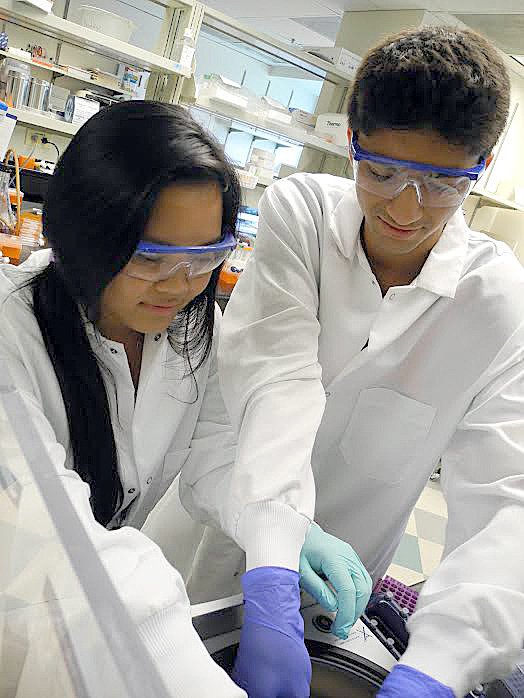
For eight weeks this past summer, Chokshi conducted an extensive molecular biology research project where the goal was to learn techniques in molecular cloning. He said the process is basically isolating a desired piece of DNA, such as a human gene, amplifying a few copies of the DNA molecule into millions, and then manipulating the DNA for future experimental work. All in the hopes of finding a cure for cancer.
“This technique of cloning is a fundamental investigative procedure in molecular biology and used to identify and develop medications and treatments for cancer,” Chokshi said. “I conducted extensive biomedical research and performed these experiments using an advanced technique called Gibson cloning, which was just developed a few years ago.”
For Chokshi, the hardest part was becoming adjusted to the research center’s environment.
“I had to acclimate to the Hutch lab environment compared to the high school lab environment,” he said.
His mentors were Dr. Robert Bradley, Ahmad Zebrari and Janine Ilagan. Chokshi said they taught him everything he learned during the process, from lab techniques and experimental designs to research insight.
“I was fortunate to get the opportunity to work with world-renowned scientists who pioneered this research,” Chokshi said, explaining that over the past couple of decades, the center’s work has led to unfathomable discoveries. Chokshi said the Hutch has boosted the survival rate of bone-marrow and blood stem-cell transplantations from 0 to 85 percent, which, according to Chokshi, is “unheard of.”
And with this experience, it would be a shame if Chokshi didn’t want to pursue medicine.
“I haven’t decided on my major yet, but am considering either biochemistry or molecular biology, and then minoring in humanities,” he said. “All of my college applications have been submitted already, now just waiting with baited breath to find out by late March or early April. Waiting is the most difficult part.”
Chokshi said he was extremely fortunate to have been able to participate in the internship and gained valuable insight he had been hoping for.
“I really enjoyed working with the mentors, gaining firsthand experience at the lab and interacting with students interested in a similar career. I would highly recommend this opportunity to any high school student who is interested in the natural science of biomedical engineering.”

Volunteering in Africa
Grace Adler spent three of her summer weeks in Ghana, volunteering with an organization called Free the Children.
While there, Adler helped build a school, learned about the culture and participated in leadership activities.
“Free the Children not only helps the communities they work in, but they also help the students who go on the trips, like me, to learn about being a leader, inspiring us to continue volunteering once we arrive back home,” Adler said.
In the summer of 2012, Adler traveled to Ecuador with Free the Children and said she had an amazing time.
“I love how it makes me feel when I am able to help other people,” Adler said. “So it was an obvious choice to do community service for my project.”
But Ghana was different from her Ecuador excursion, as Adler had to pay for a majority of the trip herself. She got a job at the beginning of her junior year and put every paycheck into a savings account.
“By the end of the school year, I was very proud of the amount I had saved and the discipline I showed when saving up for something I really wanted,” she said.
With her savings, Adler took off for Africa.
For Adler, the hardest part of her three weeks was physically building the school. They mixed and carried the cement before stacking the bricks of the house, and all in the scorching heat.
“When I was building the school, I was hot and exhausted,” Adler said. “But then I thought about how much the community appreciated what we were doing and how it would change their lives.”
Her mentor was Spencer West, the facilitator of the trip
and a motivational speaker for Free the Children.
“On the trip he showed me that no matter what challenges you face in life, you can always overcome them and make a change in the world,” Adler said. “He inspires me every day to be a better person and do what I can to make a difference in the causes that I’m passionate about.”
Adler presented her project last week and said it went great. She plans on continuing to volunteer with Free the Children and also wants to get involved locally. She has been accepted to five schools, including the University of Oregon and Western Washington University. She is still waiting for two schools to get back to her. She is unsure where she would like to go come fall, but knows that she wants to study communications.