Man who lived through Issaquah’s history, docents at local museum | Photos
Published 12:30 pm Friday, September 2, 2011
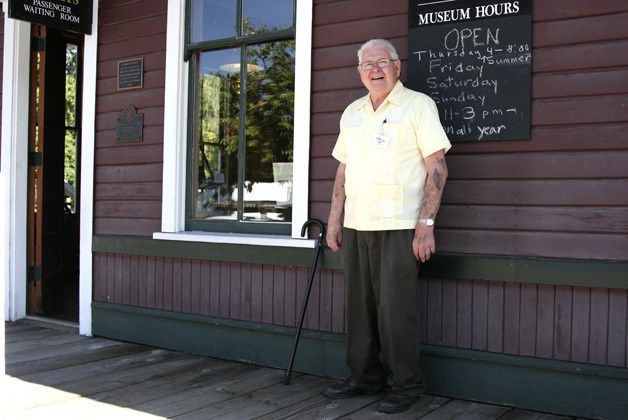
Resting his hands on a cane, Roy Peterson sits back on a wood bench inside the old historic train depot, his memory as sharp as pick axe.
Coal mining relics fill the cases of the little museum and shed light on Issaquah’s past, but they’re nothing compared to what’s inside Peterson’s mind.
He was the man who named Issaquah’s streets, after all.
Volunteering as a docent at the museum every month, the 84-year-old tells his stories to anyone willing to listen.
“Did I bruise your ear?” he says, smiling wide. “I could go on for hours.”
The few that stop for a moment will hear firsthand how a town of 1,200 transformed into a bustling city.
“I really believe you’re losing the history unless you hear some of these stories,” he said. “There is not many of us left.”
While Peterson has something special to offer, Issaquah History Museums is looking for volunteers from all backgrounds to help cover its visitor hours.
There is always a need for more docents, and the variety is welcome, said Karen Klein, the museums’ volunteer coordinator. “At the history museums, you never know who you’re going to attract.”
Peterson found the history museum a few months ago after he participated in an oral history project.
He served on the City Council through the ‘50s and ‘60s, so he can recall the intimacies of old city dramas.
After the project, he kept coming back, Klein said. “He just kept appearing saying that, ‘My memory is still good. you should gather it from me.’”
So they asked him to consider being a docent.
A volunteer all his life, it was an easy decision, Peterson said.
He first came to the small town as a ninth-grade civics teacher at Issaquah High School in 1952.
At the time Issaquah wasn’t large enough to hold general elections for its city councilmembers. Instead, they were voted in at town hall meetings, but few people attended.
He pressed his students to encourage their parents to show up to the meetings, so the same group of people wouldn’t keep control of the city.
As parents began to show up, Peterson grew in popularity.
“The next thing I knew, I got nominated,” he said with a laugh.
While he was unsure if he wanted to be a councilmember, he accepted the position and eventually took to politics.
During his first term, the town grew large enough to add two more councilmembers and to get house-to-house mail delivery.
Mail delivery meant the city had to name it streets and assign house numbers.
Peterson and Clive Berry, the town florist, wanted Issaquah to create its own system, but they were opposed by the other two councilmembers, who wanted to adopt the county’s numerical system.
So they put it to a vote, and about 80 percent of the residents wanted their own street names.
At the next meeting, Peterson told the councilmembers it was a sign that he understood the community more than they did, but this came back to bite him.
The city couldn’t afford to pay someone to name the streets and number the homes, so Mayor J.W. Flintoft turned to the two men who supported the measure.
“He said, ‘Guess whose going to have to do it?’” Peterson said with a laugh. “You’re going to have to do it.”
They decided to split the town on the Sunset Highway, the major road that ran through town.
Peterson took responsibility for the south half of town, and named the streets alphabetically after local pioneers – Adams, Bush, Croston.
Berry, the florist, wanted to name his streets after flowers, but they’re too hard to spell, so he switched to trees – Alder, Birch, Cedar, Dogwood.
At the museums, a collection of photos show men going to work in the Issaquah coal mines. Peterson points to a map plotting mines beneath Cougar Mountain.
To this day, old collapsed shoots pose a risk to hikers who explore off trail, he said.
The entrances were all blocked off after they were closed, but there was a time when he considered reopening them.
John F. Kennedy came on the television to warn the public about the Cuban Missile Crisis, and Peterson had the idea that the town could hide in the tunnels.
“We’re so close to Seattle, if someone starts shooting missiles at Seattle, it could be real easy for one to miss,” he said.
His neighbor was once a miner, and he took Peterson to the entrance, which was blocked by logs. It would do the job, and it was close to town, but it was never needed.
Peterson has had a lifetime career in public service. He was a founding trustee at Bellevue Community College, served on the Overlake Hospital board and spent 20 years volunteering at the Issaquah visitor’s center.
Issaquah History Museum
Phone: 425-392-3500
Train Depot
11 a.m.-3 p.m., Friday, Saturday and Sunday
50 Rainier Blvd. N, Issaquah
Suggested donation, $1-2
Gilman Town Hall
11 a.m.-3 p.m., Thursday, Friday and Saturday
165 SE Andrews St., Issaquah
Suggested donation, $1-2

Roy Peterson, who first named the streets in Issaquah, waits for visitors to come visit the Issaquah Train Depot.

Roy Peterson, who first named the streets in Issaquah, tells the story of the city’s past to visitors at the Issaquah Train Depot.