Fighting wild fires in 1958, how Bandera Mountain burned | Photos
Published 1:57 pm Tuesday, November 1, 2011
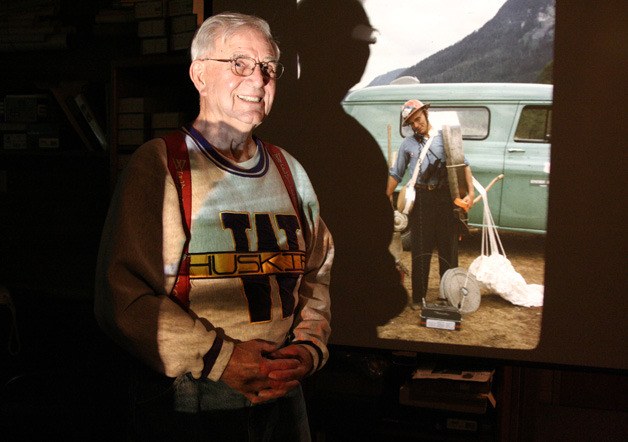
Slides of Bandera Mountain consumed in flame click in and out of a projector in the basement of a Sammamish home.
A picture of a man tipped over with gear, a windsock draped over his shoulder, pops up on the screen.
While Ben Harrison, now 86, had plenty of equipment, he still fought the 1958 fire in a button down, sleeves rolled above his elbows.
The fire blazed a week and a half, scorching six miles along the I-90 corridor. It was another three months and a second swell of fire, before the U.S. Forest Service put out the flames.
His story has shown how forest fighting has changed from a community effort to the responsibility of well-trained teams.
Harrison was working near Mt. Rainier, when he heard the alarm.
The fire began when an East wind picked up a spark from a burning slash pile, which loggers had lit, Harrison said. “It spread like a match on a patch of dry grass.”
He grabbed his powder box, a waterproof dynamite box, where he kept a change of clothes and needed toiletries.
At the time, it was lawful for the Forest Service to stop men on the highway and force them to help fight the fire in whatever they were wearing. At the time U.S. Highway 10 had yet to be named I-90.
The Forest Service also sent a bus to Pioneer Square in Seattle to pick up workers, Harrison said. “They just sort of swept the streets.”It was a motley crew.
A slide of a man with missing teeth, scraggly long hair and a bright smile popped up on the screen.
“He was a good worker,” Harrison said, “but you couldn’t separate him from a bottle of wine.”
As soon as the camp was established, Harrison was trying to figure out why he was running short of sleeping bags, when he discovered that “working” girls had moved into the camp.
Surprised by how quickly prostitutes had moved into the camp, they had Washington State Patrol help clear out the women.
The fire crews used water from streams, and sometimes there was enough pressure that a pump wasn’t necessary.
Although the crews didn’t have fire-retardant garb, a steady stream of water was shot at the front nozzle-man to keep him cool.
“You’d just be sopping wet,” Harrison recalled.
The Forest Service used helicopters for one of the first times for fire control. The crews built landing pads atop the mountainside to bring in more crews.
Biplanes were also used to dump chemicals on the mountainside.A couple months after the fire was under control, it reignited and burned another day and a half.
At first, they thought it was caused by campers, but they later discovered that a tree had burned from the inside out, and sparks shot out of its holes.
While tall timbers now fill the mountainside, remnants of the fire remain. A trail built by the fire crew has been rebuilt and renamed Ira Springs.
After spending a summer on Bandera, Harrison eventually singed his lungs and gave up the work.
He went to work at Boeing, and in 1966, graduated from the University of Washington’s Forestry College.
He went to work at Weyerhauser for 17 years. His work there determined Snoqualmie’s landscape even today.
He also worked with city’s to help maintain their forest lands. Thanks to his contribution in Issaquah the Lake Tradition Plateau has a thriving forest, and Round Lake doesn’t have a power substation built around it.
At his Sammamish home, Harrison flips open a retirement made with two hand-cut shingles. Two red Weyerhauser suspenders tuck in his Husky sweatshirt.
Turning pages filled with photos, he lands on a note from a Puget Power supervisor, who worked with him on the Issaquah project.
“The city of Issy owes you a big ‘thanks’ for all your help and guidance in getting the Lake Tradition area organized and operating profitably,” he wrote. “You have been a friend to the city and I’m happy to say a personal friend.”

Ben Harrison, summer 1958, outside Bandera Mountain

U.S. Forest Service used helicopters to fight fires for one of the first times on Bandera Mountain in 1958.

A tree burns during the Bandera Mountain fire in 1958.

Men extinguish smoking stumps after a fire on Bandera Mountain took out six miles of forest in 1958.